
Who Pays Closing Costs on a VA Loan?
VA HOME LOAN ACADEMY | LESSON 2 of 12
One of the biggest misconceptions I hear is that you’ll never need money for closing costs on a VA loan.
That’s not always true.
The good news is there are often far more options available than most Veterans realize. This might be a surprise, but you may not have to pay all of the closing costs yourself.
One of the greatest strengths of the VA home loan program is its flexibility. There are several ways to reduce your out-of-pocket expenses – you just need to know what’s available and have a team that understands how to structure the contract.
That’s what this lesson is all about.

MISSION BRIEF
Today’s mission is simple.
Let’s clear up one of the biggest misunderstandings about VA home loans and show you how a smart financing strategy can help you keep more money in your pocket.
First Things First…
What Are closing costs on a VA loan?
Closing costs are the expenses involved in finalizing your home purchase. They typically include things like:
- Lender fees
- Title services
- Recording fees
- Appraisal
- Homeowners insurance
- Property taxes and escrow set up
- Other transaction costs
These costs are separate from your down payment.
The good news?
With a VA loan, there are often several ways to reduce what you actually bring to closing.
FOR REALTORS
Most realtors have heard about the VA’s 4% seller concession rule. What many don’t realize is that’s only one piece of the puzzle.
This is one of the reasons I enjoy working with experienced buyer’s agents. The best Realtors understand that writing the contract is about more than agreeing on a price – it’s about protecting their client’s interests and using every available benefit wisely.
There are often additional ways to structure a transaction that benefit a Veteran buyer.
A seller may be able to pay many of the buyer’s normal closing costs on a VA loan, and certain additional seller concessions may also be available under VA guidelines.
Every transaction is different.
The key is bringing your lender into the conversation early so the contract can be structured in the smartest way possible.

One of the Best Parts of a VA Loan
Many people know a VA loan can require no down payment.
Fewer people realize there are additional ways to reduce out-of-pocket costs through the purchase contract.
Depending on the situation, sellers may be able to help by contributing toward allowable closing costs on a VA loan and, in some cases, additional seller concessions permitted under VA guidelines.
That’s why I always encourage Veterans to talk with their Realtor and Lender before assuming how much cash they’ll need.
FOR REALTORS
Knowing the difference between seller-paid closing costs and seller concessions can help you structure stronger offers and set accurate expectations for both buyers and sellers.
If We Were Sitting Together
One of the biggest mistakes I see isn’t that people make the wrong decision. It’s that they never ask the question because they assume they already know the answer.
The thing I enjoy most about working with Veterans is helping them understand what’s possible.
I’ve talked with people who assumed they needed tens of thousands of dollars to buy a home because nobody had ever explained how their VA benefit actually works.
That’s why I like starting with a Total Cost Analysis instead of guesses.
Once we put the numbers on paper, the conversation changes. Instead of wondering what might happen, we can make decisions based on real options.
Let’s Look At The Numbers
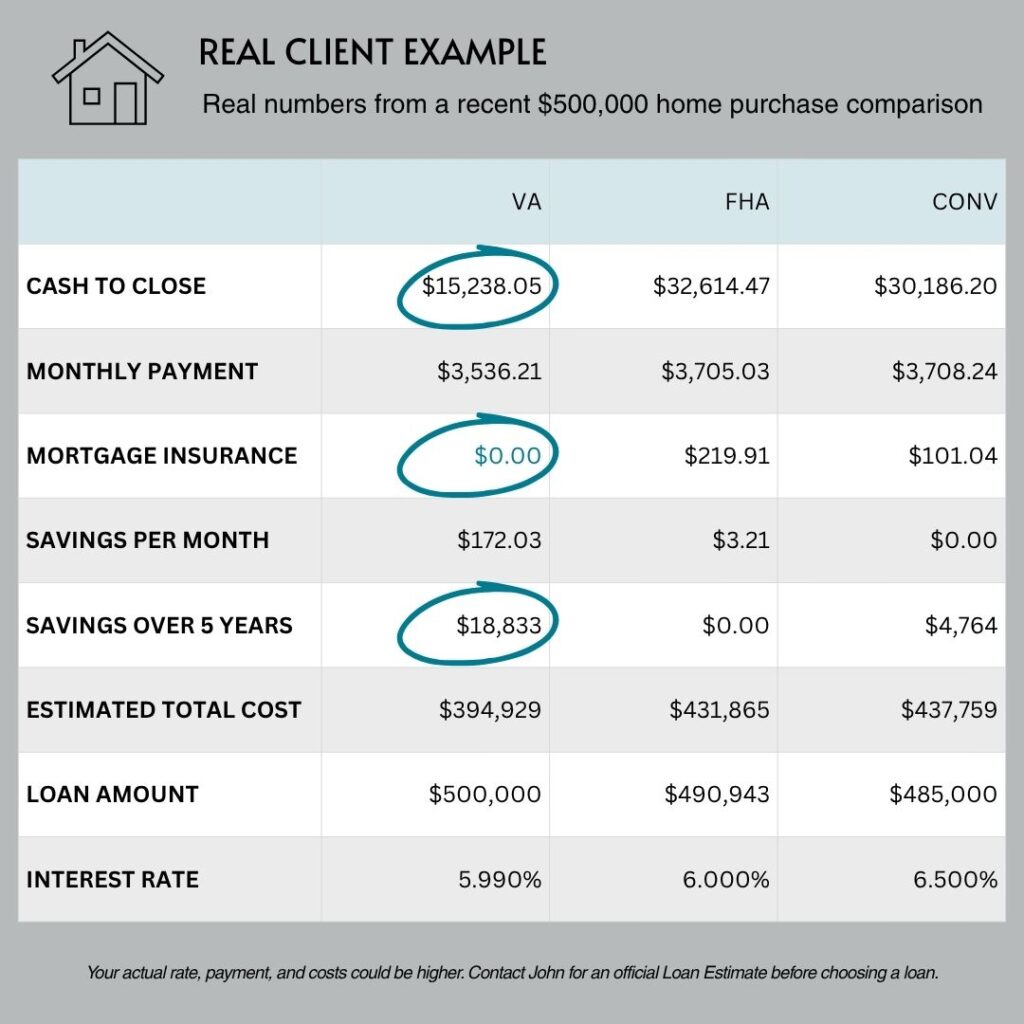
This is a real Total Cost Analysis that I prepared comparing financing options for $500,000 home purchase. Let me point out the highlights here in favor of a VA loan:
Sometimes the VA loan saves a little.
Sometimes it saves a lot.
The important thing is making a decision based on numbers – not assumptions.
- About $17,000 less cash to close than the FHA example
- No monthly mortgage insurance
- Nearly $19,000 saved over 5 years compared to FHA
Every home purchase is different, but this is exactly why I prepare a Total Cost Analysis before my clients make an offer. It lets us compare real numbers instead of making assumptions.
What Is the 4% Rule on a VA Loan?
The VA’s 4% rule is probably one of the most misunderstood parts of the program.
Many people think it means a seller can only contribute 4% toward a Veterans closing costs.
That’s not what it means.
The seller may pay many of the buyer’s normal closing costs without those payments counting toward the 4% concession limit. The 4% rule applies to certain additional concessions permitted under VA guidelines.
Understanding that distinction can create opportunities many buyers – and even some Realtors – don’t realize exist. Go to Lesson 4 to dig deeper into the 4% Rule.
One Last Thing…
The VA home loan isn’t just a mortgage program,
It’s a benefit earned through military service.
When someone volunteers to serve our country, they’re making an extraordinary commitment. I think it’s worth taking the time to make sure they receive every benefit available to them.
Too often, I meet Veterans who simply didn’t know what was possible. That’s why this Academy exists.
Not to convince anyone to buy a home.
To make sure Veterans – and the Realtors helping them – understand the opportunities available so they can make informed decisions.
A Few More Questions about Closing Costs on a VA Loan
In many cases, sellers can pay all of a Veteran’s normal closing costs. There are also additional seller concessions permitted under VA guidelines. A knowledgeable Realtor and lender can help structure the contract to maximize the benefits available to you.
For many eligible Veterans, yes. A VA loan can allow you to buy a home with no down payment. However, “zero down” doesn’t always mean “zero out-of-pocket”. That’s why I prepare a Total Cost Analysis before you start shopping.
Often, yes. Many Veterans are surprised to learn they may be able to reuse their VA home loan benefit. We’ll cover how that works in Lesson 6: Can You Use a VA Home Loan More Than Once?
Not every property meets VA guidelines. The home must generally be safe, structurally sounds, and intended as your primary residence. We’ll explain property requirements in Lesson 3 of the Va Home Loan Academy.
Absolutely. One of the biggest advantages of speaking to your lender early is understanding how much cash you’ll actually need at closing. Together with your Realtor, your lender can help structure an offer that makes the most of your VA home loan benefit.
Still have questions? Let’s talk.
Every Veteran’s situation is unique. If you’re wondering how these guidelines apply to your goals, I’d be happy to walk through your options and prepare a Total Cost Analysis.
NEXT LESSON (Coming Soon)
VA Loan vs Conventional Loan
You’ll learn when a VA loan is a stronger option and when to use a conventional home loan.

Pull Up A Chair
Hey, I’m John.
You know, my dad was a Veteran. He never used the home loan benefit he earned, and I’ve often wondered what might have been different if someone had taken the time to explain it to him.
That’s really why I do this.
I’ve been in this business since 2015, so I know a thing or two (or three). If you’ve got questions, give me a call. We’ll sit down, go through everything together, and see what makes sense for you. Even if you’re just getting started.
Whenever you’re ready, I’m here. Just reach out.
JOHN WALOWAC
Senior Mortgage Advisor, NMLS #1414681
571-212-9281
jwalowac@theyiteam.com
Monday – Friday ▪️ 8:30 am – 5:30 pm
Licensed in Virginia ▪️West Virginia ▪️Maryland ▪️Washington DC
This article is provided for educational purposes only and should not be considered legal, tax or financial advice. VA home loan eligibility is determined by the US Department of Veterans Affairs, while loan approval is subject to lender underwriting requirements. Eligibility, funding fees, loan limits, interest rates, and program guidelines may change without notice.
Not all applicants will qualify. Loan approval depends on factors including credit history, income, assets, debt obligations, occupancy requirements, and property eligibility.
VA loans are available to eligible Veterans, active duty service members, certain members of the National Guard and Reserve, and qualified surviving spouses. A Certificate of Eligibility (COE) may be required.
If you’re wondering how these guidelines apply to your situation, I’m happy to walk through your options and help you determine the best path forward.