
What Are The Rules For A VA Loan?
VA HOME LOAN ACADEMY | LESSON 1 of 12
One of the first questions I hear from Veterans is, “What are the rules for a VA home loan?”
It’s a fair question.
There’s a lot of information online. Some of it is accurate. Some of it is outdated. Some of it is simply misunderstood.
I’ve also found that many realtors aren’t completely familiar with VA financing because the guidelines change over time, and they may not work with Veteran home buyers every day.
The good news is this: the VA home loan program is one of the best home buying benefits available. Once you understand the basic rules, the process becomes much less intimidating.
My goal isn’t to overwhelm you with mortgage terminology. It’s to explain how the program works, why the rules exist, and how they apply to real people looking to buy a home in Maryland, Virginia, West Virginia or Washington DC.

MISSION BRIEF
Today we’re clearing up the biggest misconceptions about VA home loans so you can move forward with confidence.
Rule #1
You Must Be Eligible For The VA Home Loan Benefit
The first rule is simple: you must qualify for the VA home loan benefit.
Eligibility is generally available to:
- Veterans
- Active-duty service members
- Certain National Guard and Reserve members
- Some surviving spouses
One of the first things we’ll do together is obtain your Certificate of Eligibility (COE).
Don’t let the name intimidate you. It’s simply the VA’s way of confirming you’ve earned this benefit through your military service. In many cases, I can help obtain it as part of the mortgage process.
Why This Rule Exists
The VA doesn’t lend money directly. Instead it guarantees a portion of your loan to approved lenders, like me. Your certificate of Eligibility tells us you’ve earned access to that benefit.
JOHN SAYS…
One of the biggest misconceptions I hear is that getting your Certificate of Eligibility is difficult. For most Veterans, it’s much easier than they expect. If you aren’t sure whether you’re eligible, let’s find out together. It’s often a quick conversation.
FOR REALTORS
Many realtors aren’t completely familiar with VA financing because the guidelines change occasionally. When you’re not following it every day, it’s easy to miss an update.

Rule #2
Can I Buy Any House I Want?
Not quite.
One of the rules of a VA home loan is that the home must generally be your primary residence. The program is designed to help Veterans become homeowners, not purchase vacation homes or investment properties.
The property also has to meet the VA’s Minimum Property Requirements (MPRs).
That doesn’t mean the home has to be perfect. It does mean it should be:
- Safe
- Structurally sound
- Sanitary
Examples of issues that may need to be addressed before closing include:
- Major roof leaks
- Unsafe electrical systems
- Heating systems that don’t function properly
- Serious termite damage
- Health or safety hazards
- Unsafe well or septic systems when applicable
Why This Rule Exists
The VA isn’t trying to make buying a home harder.
It’s trying to protect Veterans from purchasing a home with significant health or safety issues that could become expensive problems after closing.
FOR REALTORS
VA appraisals sometimes get an unfair reputation.
Their purpose isn’t to “kill the deal”. Their purpose is to confirm the property’s value and ensure it meets basic safety and livability standards. Preparing sellers for this early can help transactions move much more smoothly.
FROM MY DESK
“I heard I need perfect credit to qualify for a VA loan. Is that true?”
No.
The VA itself doesn’t set a minimum credit score. Individual lenders establish their own guidelines, and loan approval depends on your overall financial profile – not just one number.
I’ve helped many buyers who assumed their credit wasn’t good enough, only to discover they had more options than they expected.
That’s one of the reasons I always encourage people to ask before assuming they don’t qualify.
Rule #3
Do I Need a Down Payment?
One of the biggest advantages of a VA loan is that many eligible borrowers can purchase a home with no down payment.
That’s a tremendous benefit.
But it doesn’t automatically mean putting zero down is always the best financial decision.
Every buyer’s situation is different.
Sometimes keeping cash in the bank makes the most sense. Other times, putting money down can reduce your monthly payment or help you meet other financial goals.
That’s why I don’t believe in one-size-fits-all advice.
Rule #4
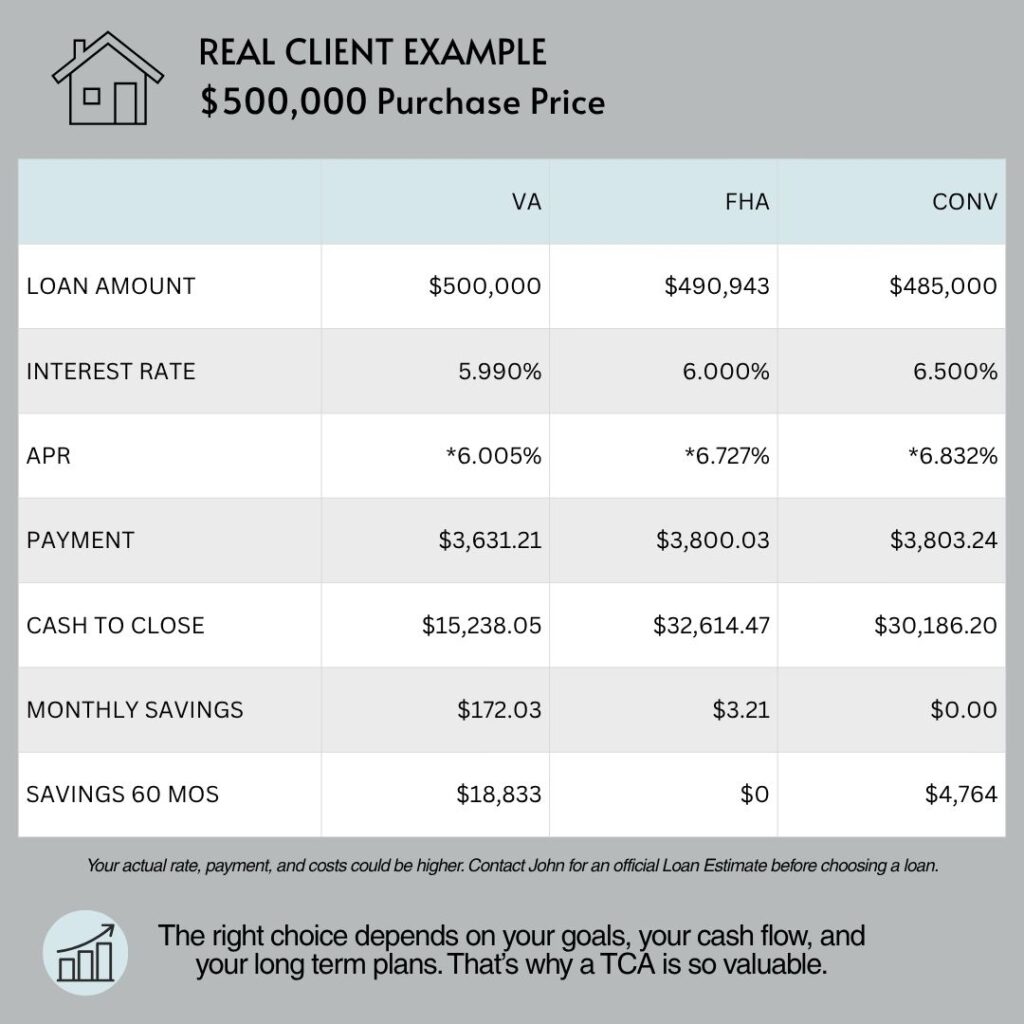
How Much Do I Need to Make to Afford a $500,000 Home?
This is another question I hear all the time.
The honest answer is: There isn’t one income number.
VA loans don’t have a minimum salary requirement. Instead, lenders look at the complete financial picture, including:
- Household income
- Monthly debt
- Credit history
- Residual income
- Property taxes
- Homeowners insurance
- Current interest rates
That’s why two families earning the same income may qualify for different loan amounts.
Rather than guessing, I prepare a Total Cost Analysis so you can see what a home at different price points would actually look like in your monthly budget.
Rule #5 What is the 1% Rule?
You may hear people talk about the 1% rule on VA loans. This refers to the VA’s limitation on certain lender charges. A lender may charge a flat origination fee of up to 1% of the loan amount instead of itemizing certain lender fees, or it may choose to itemize allowable fees instead.
The important thing isn’t memorizing the rule. It’s understanding your Loan Estimate.
If there’s ever a fee you don’t recognize, ask. A good lender should be able to exolain every line item and why its’ there.
Rule #6: What is the 4% Rule?
The 4% rule is one of the most misunderstood parts of a VA loan.
Many people believe a seller can only contribute 4% toward a Veteran’s closing costs.
That’s not acutally how it works.
The seller can pay many parts of the buyer’s normal closing costs plus up to 4% of the purchase price in additional seller concessions for certain items, such as:
- Paying the VA funding fee
- Temporary interest rate buydowns
- Paying off certain collections or judgements
- Other allowable concessions under VA guidelines
Understanding this rule can create more flexibility during negotiations, especially in changing market conditions.
Rule #7
Can I Use My VA Loan More Than Once?
Yes – many Veterans can.
Your eligibility depends on factors such as your remaining entitlement and whterh you’ve restored previously used entitlement.
We’ll cover this in much more detail in Lesson 6, because this is one of the rules for a va home loan that deserves its own conversation.
FOR REALTORS
Knowing the difference between seller-paid closing costs and seller concessions can help you structure stronger offers and set accurate expectations for both buyers and sellers.
Before you head out…Final Thoughts on the Rules for a VA Home Loan
I’ve talked to a lot of Veterans who thought buying a home wasn’t possible because of something they heard years ago. Sometimes they were told the wrong information. Sometimes they just didn’t know where to start.
That’s really why I created the VA Home Loan Academy.
If this lesson helped answer one question, great. If it raised a few new ones, that’s okay too. We’ll tackle those in the next lessons.
And if you’d rather just talk it through, I’m always happy to sit down and go over your options.
You just have to know where to start.
A Few More Questions
Yes. The rules for a VA home loan say that many Veterans can reuse their VA home loan benefit depending on their remaining entitlement and previous loan history. We’ll cover this in detail in a future lesson.
No. The VA doesn’t set a minimum credit score, although lenders establish their own guidelines. Loan approval depends on your overall financial picture—not just one number.
Sometimes, but the property must meet the VA’s Minimum Property Requirements. Homes needing major repairs may require another financing option or renovation loan.
Absolutely. VA loans are not just for first-time homebuyers. Many Veterans use their benefit to purchase another primary residence.
That’s okay. One of the first things we’ll do is verify your eligibility and obtain your Certificate of Eligibility if needed.
Still have questions? Let’s talk.
Every Veteran’s situation is unique. If you’re wondering how these guidelines apply to your goals, I’d be happy to walk through your options and prepare a Total Cost Analysis.
NEXT LESSON (Coming Soon)
Who Pays for Closing Costs on a VA Loan?
You’ll learn which costs buyers typically pay, what sellers can contribute, and how understanding your options can save you money at closing.

Pull Up A Chair
Hey, I’m John.
You know, my dad was a Veteran. He never used the home loan benefit he earned, and I’ve often wondered what might have been different if someone had taken the time to explain it to him.
That’s really why I do this.
I’ve been in this business since 2015, so I know a thing or two (or three). If you’ve got questions, give me a call. We’ll sit down, go through everything together, and see what makes sense for you. Even if you’re just getting started.
Whenever you’re ready, I’m here. Just reach out.
JOHN WALOWAC
Senior Mortgage Advisor, NMLS #1414681
571-212-9281
jwalowac@theyiteam.com
Monday – Friday ▪️ 8:30 am – 5:30 pm
Licensed in Virginia ▪️West Virginia ▪️Maryland ▪️Washington DC
This article is provided for educational purposes only and should not be considered legal, tax or financial advice. VA home loan eligibility is determined by the US Department of Veterans Affairs, while loan approval is subject to lender underwriting requirements. Eligibility, funding fees, loan limits, interest rates, and program guidelines may change without notice.
Not all applicants will qualify. Loan approval depends on factors including credit history, income, assets, debt obligations, occupancy requirements, and property eligibility.
VA loans are available to eligible Veterans, active duty service members, certain members of the National Guard and Reserve, and qualified surviving spouses. A Certificate of Eligibility (COE) may be required.
If you’re wondering how these guidelines apply to your situation, I’m happy to walk through your options and help you determine the best path forward.